Drawn line by line
Every line of SEPIA is faired by hand and checked in the flow simulation before it is fixed. These are fragments of the forward body; the complete lines plan stays with the designer.
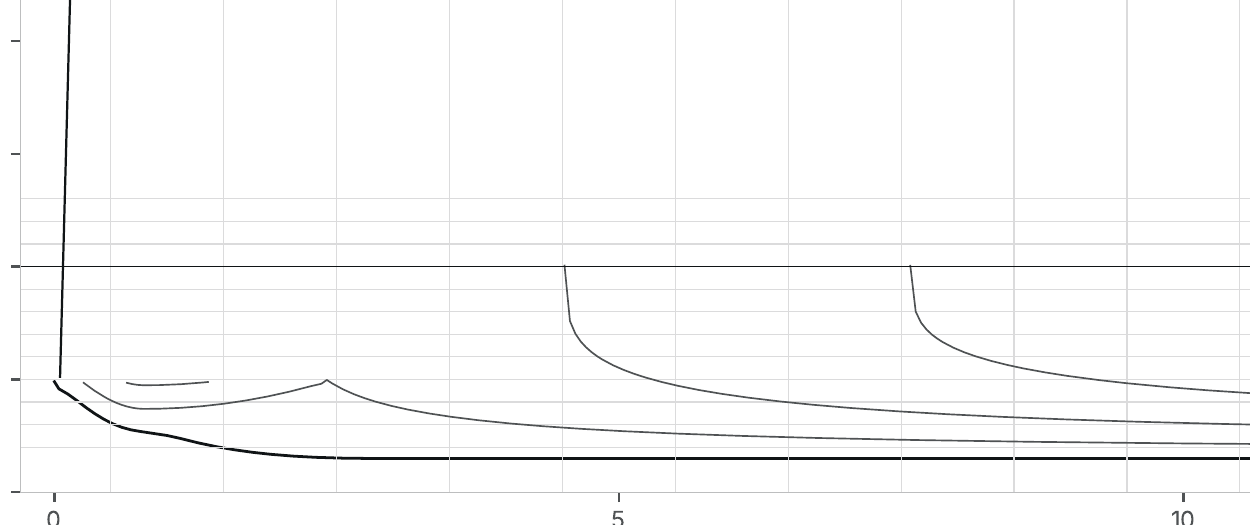 Profile, forward body
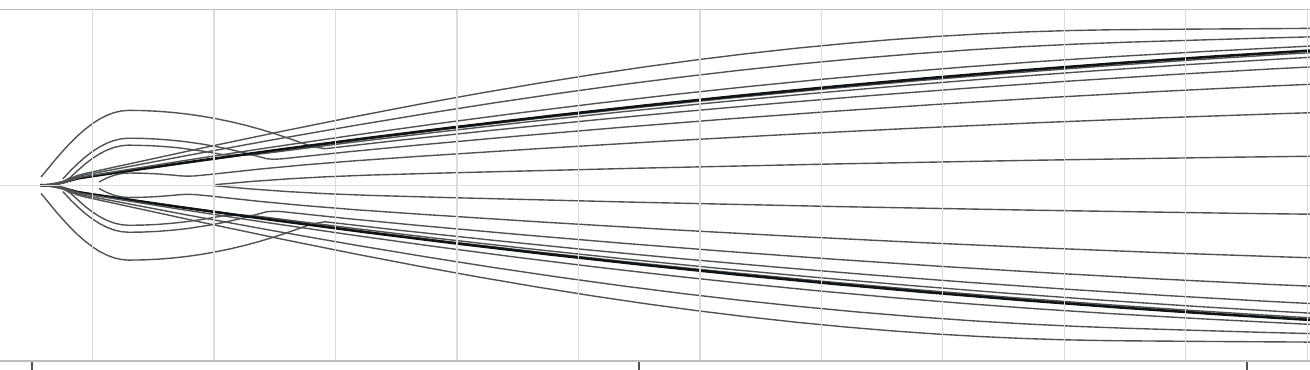 Waterlines, forward body
Stingray Yachts · hull form
An ocean-going catamaran hull with nothing below its keel.
A catamaran hull form by Stingray Yachts, drawn around electric drive and offered to other builders and projects. Nothing hangs below the keel, and the boat turns on the spot.
A displacement monohull of 24 metres meets a wall at about 13 knots: the wave it makes becomes the limit, and every extra knot costs a great deal of power. Two slender SEPIA hulls pass that point far more easily.
At 14 knots SEPIA needs about 30% less than a monohull of the same length and weight. At 16 knots it needs half. At 10 to 12 knots a monohull is more economical, and we say so: the catamaran earns its keep at cruising speed, in comfort and in space.
Power needed to move the boat, SEPIA against a monohull of the same length and weight.
Every line of SEPIA is faired by hand and checked in the flow simulation before it is fixed. These are fragments of the forward body; the complete lines plan stays with the designer.
Profile, forward bodyWaterlines, forward bodyMost catamarans carry their propellers on shafts, brackets and rudders that hang below the hull. SEPIA was designed around its electric drives from the first line. The result is a clean underwater body and a boat that can be taken where others cannot.
Calculated on the same hull at 12, 14 and 16 knots: no shaft lines, brackets or rudders in the water.
The propellers never reach below the hull line. In shallow water the hull, not the drive, meets the bottom first.
Each drive turns all the way round. The boat moves sideways and turns in its own length, with no bow thruster.
No shaft alignment, stern tubes or rudder stocks to look after.
Both drives answer a single joystick. The skipper slides the boat sideways onto the quay, holds it against wind and turns it in its own length with one hand.
With joystick berthing and no thruster or rudder gear to manage, a couple can handle the boat in harbour.
At 10 knots SEPIA uses about 3.5 litres of diesel per nautical mile. One of the two generators carries the boat on its own for more than 3,000 nautical miles. At the design displacement one generator is also enough for 12 knots.
The second generator joins for the 14-knot cruise. With the batteries and a 35 kWp solar roof the boat lies at anchor for about 21 hours in silence, and for about a day and a half with sun.
| Speed | Fuel per mile | Generators running |
|---|---|---|
| 10 kn | 3.5 litres | one |
| 12 kn | 7.9 litres | one |
| 14 kn | 12.2 litres | two |
One generator carries the boat at 10 knots; both run at 14.
Calm water at the design displacement, hotel load included.
At 10 knots one fill of 15,000 litres carries SEPIA further than an Atlantic crossing from the Canaries to the Caribbean, with miles to spare. Distances are approximate great-circle routes.
Two diesel generators, a large battery and a solar roof all feed one electric bus. The drives never care where the power comes from: the boat can cruise on the generators, glide in silence on the battery, or sit at anchor on the sun.
Both drives turn through a full circle and answer one joystick.
Compared with the same hull on conventional shafts, brackets and rudders, the SEPIA drives need 9 to 10 percent less power. Over ten seasons of 3,000 miles a year at 14 knots that adds up.
No shaft lines, stern tubes, brackets, rudders, steering gear or bow thruster to buy, align, grease and repair.
No shaft alignment and no rudder bearings to renew at haul-out.
Assumptions: 3,000 nautical miles a year at 14 knots, calm-water fuel figures at the design displacement, diesel at €1.40 per litre. Your savings depend on how and where you cruise.
Calculated heel with the wind on the beam, at the design displacement.
calculated in a force 10 wind on the beam. A 12 m beam gives a platform that barely rolls, at sea or at anchor.
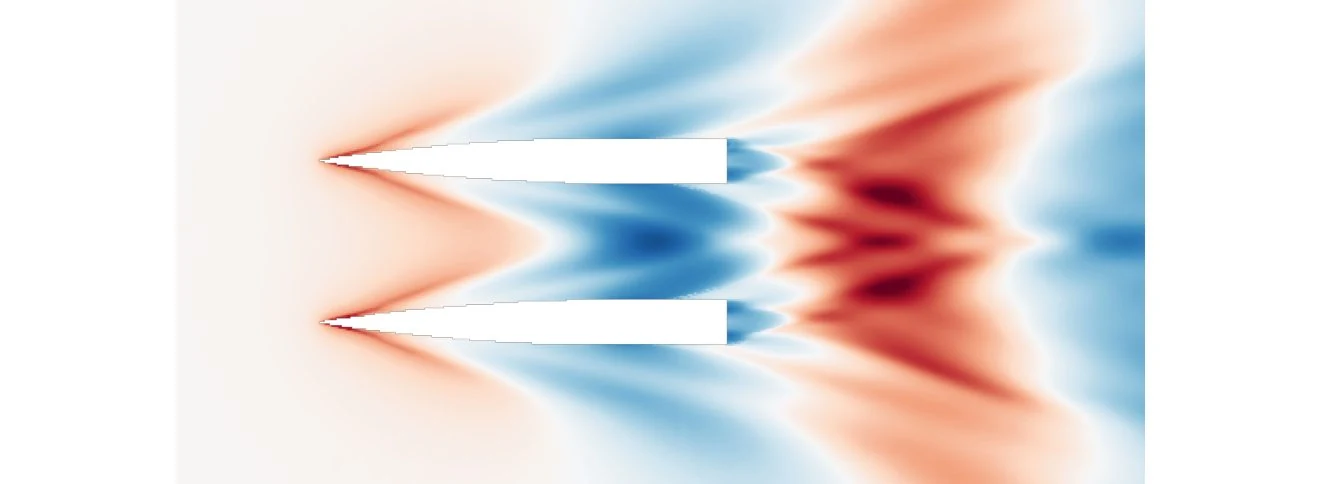
At every speed from 10 to 16 knots the waves between the hulls stay well below the bridge deck in calm water, with more than 1.2 m to spare.
SEPIA is being designed to CE design category A, the category for ocean passages.
A strong metal hull that can be repaired anywhere in the world.
The design figures behind the pages above: principal particulars, the flow simulation of the complete catamaran, propulsion, fuel and range in service condition, and stability. Speeds and fuel in service condition are at half fuel, 90.4 t; the figures further up are at the 83 t design displacement.
| Length overall / hull | 23.90 m |
| Beam overall · hull centres | 12.00 m · 9.37 m |
| Demihull waterline beam | 2.63 m |
| Material | marine aluminium, flat and single-curvature plating |
| Displacement | 96.7 t full load · 90.4 t half fuel · 77.6 t light ship |
| Draught | 1.65 m full load · 1.58 m half fuel · nothing below the keel |
| Propulsion | two electric pulling pods, 360° azimuthing; joystick standard; no rudders, no bow thruster |
| Generating plant | diesel-electric DC bus: 2 × 13-litre marine diesel engines (Sweden) driving permanent-magnet generators (Finland); battery 400 kWh |
| Fuel | 2 × 7,500 l |
| Speeds (half fuel) | 14 kn cruise on two generators · 10 kn economy on one · 15.0 kn on the generators, 16 kn with battery |
| Design category | designed for CE category A (ocean) |
Viscous free-surface computation of the complete catamaran with its bridge deck, free to heave and pitch, in calm sea water at 83 t. Total resistance is the computed pressure resistance plus ITTC-57 friction.
| Speed | Total resistance | Effective power | Sinkage | Trim (+ by the stern) |
|---|---|---|---|---|
| 10 kn | 14.2 kN | 73 kW | 7 cm | −0.6° |
| 12 kn | 32.0 kN | 197 kW | 13 cm | −0.1° |
| 14 kn | 50.1 kN | 361 kW | 15 cm | 1.0° |
| 16 kn | 60.3 kN | 496 kW | 11 cm | 1.3° |
Free surface around the catamaran, flow from left to right; red is crest, blue is trough (±0.9 m). The crest between the hulls stays well below the bridge deck: the smallest clearance under way is 1.2 to 1.5 m over 10 to 16 knots.
For the same hull and the same resistance, the SEPIA pods need 8 to 10% less propeller power than two inclined shafts with brackets and rudders, each with its own optimised propeller.
Speeds and fuel at half fuel (90.4 t); range from a full tank of 15,000 litres to 10% remaining, the boat getting lighter along the way. Calm water, clean hull, no reserve.
| Speed | Generators running | Fuel per mile | Range from a full tank |
|---|---|---|---|
| 10 kn | 1 of 2 | 3.8 l | 3,580 nm |
| 12 kn | 1 of 2 | 8.5 l | 1,575 nm |
| 14 kn | 2 of 2 | 13.4 l | 1,011 nm |
| 16 kn | 2 of 2 | 16.1 l | 836 nm |
Metacentric height about 21 m, maximum righting lever 4.3 m at 14 to 16 degrees, positive to about 90 degrees; heel about one degree in a 28 m/s beam wind.
Every figure on this page comes from computer simulation of the water flow around the complete catamaran and from the design calculations of weight, stability and power.
Figures are for calm water at the design displacement of 83 t unless stated. The monohull comparison uses a displacement monohull of the same length and weight; above 13 knots it is indicative. Range is from a full tank to 10% remaining, without reserve. Final figures depend on the completed design and equipment.