Stingray Lab · Engineering services

Numbersbefore steel

Naval architecture, CFD, certification and build management. We specialise in catamarans and trimarans with foils — and we calculate any hull.

Specialisation

Foil-assisted catamarans and trimarans: foil, hull and structure designed together, in one bureau.

Any hull

CFD, stability, structure and certification for monohulls, catamarans and trimarans.

Verified

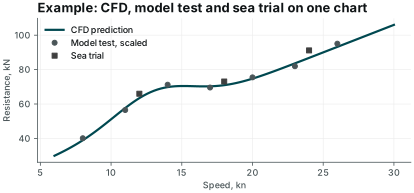
Every CFD study is cross-checked; where it matters we verify it in the towing tank in Varna and on sea trials.

Certified

The CE technical file below 24 m; the full class and flag service from 24 m.

Built

We build in the EU with our own team and manage the build for the owner — one contract, one schedule, one team.

Unique designs

Working drawings for one-off designs and interiors adapted to the real hull, ready for the yard and the joinery shop.

Digital

Thousands of hull variants in a night; every drawing revision checked against the rules within a working day.

What only we offer

A typical bureau and Stingray Lab

Most engineering bureaus sell drawings and calculations. We take a yacht from the first question to the delivery — and check every step digitally.

Typical bureauStingray Lab
Foils on multihullsHull designed first; a foil, if any, added by a specialist laterFoil, hull and structure designed together and compared in CFD with and without the foil
PerformanceCFD or a tank test, usually one of the twoCFD cross-checked, verified in the tank in Varna and on sea trials, all on one chart
Hull variantsA handful, chosen by experienceThousands screened in a night; the best run in full CFD
Rule complianceChecked when the file goes to the notified body or classEvery drawing revision checked within a working day
Contract and specificationRead by the lawyerEvery line cross-checked against the drawings and the weight book before you sign
Unique designsConcept handed to the yard to interpretComplete working drawings, designer's intent kept
InteriorDrawn by the designer, fitted by the yardAdapted to the real structure, weights and rules; joinery production drawings
BuildEnds with the drawingsWe build with our own team and manage the build for the owner
After deliveryA binder of manualsA digital assistant that knows the yacht and answers the crew in any language
QuotationAfter a meeting, in weeksIn writing, the same working day

Where to start

Small, fast entry services

Every service is described the same way, so you can compare and order without a meeting. Each entry service is small, fast and credited against the larger step that follows.

The question
What the service answers for you, in one line.
The work
What we do, by which method and to which standard.
You receive
The documents and files you hold at the end.
We need
What you send us to start. Lead time runs from the day we have it.
Code
Quote the code to Marina or to sales@stingray-yachts.com and you receive a written quotation the same working day.
ServiceThe questionNext step
I1 Foil checkIs a foil worth it on your multihull?Credited against I8
A1-S CFD snapshotA real CFD answer for any hull in days.Credited against A1
A0 Desk checkDo a seller's speed and range figures add up?—
B4-R Design reviewIs the design you hold sound?Credited against B4
D-0 CE readinessHow far is this boat from CE marking?Credited against the CE package
G8 SurveyWhat condition is she really in?—

How a project runs

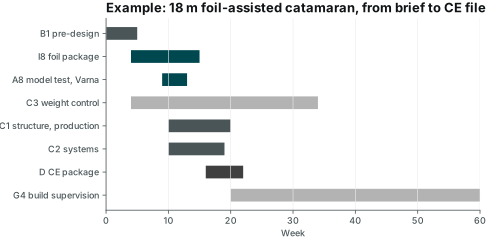
From the brief to the CE file

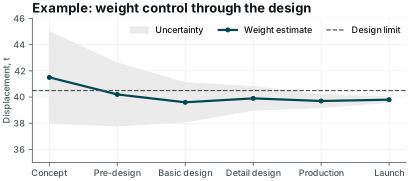
A new 18 m foil-assisted catamaran, from the owner’s brief to the CE technical file and the build. The foil, the model test and the structure run in parallel, and the weight is watched from the first week to launch.

Example programme · durations depend on scope and inputs
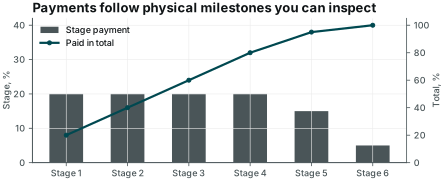
Stage payments for a build · 20 / 20 / 20 / 20 / 15 / 5 %

I · 9 services

Foils for catamarans and trimarans

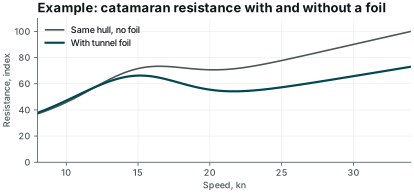
Our specialisation. A foil changes how a multihull runs: trim, wetted surface, spray on the bridgedeck, loads on the hull. We design the foil, the hull and the structure together, in one bureau, and test the result in CFD against the same hull without a foil before a single plate is cut.

Example output · illustrative, not client data
I1

Foil check

Is a foil worth it on this hull?

CFD of your catamaran or trimaran with and without a foil at three speeds. A clear go or no-go with the gain or loss in resistance at each speed.

You receive
Comparison report with resistance and trim curves; recommendation on foil type and position.
We need
Hull surface, displacement and LCG; speed range.
I2

Hydrodynamic foil design

What foil, where, and at what angle?

Section, span, chord and angle of attack; position against the LCG; lift and drag curves; cavitation margin at top speed. Tunnel foil between the demihulls, or main-hull and ama foils on a trimaran.

You receive
Foil geometry (3D), lift and drag curves, design-point table, cavitation check.
We need
Hull surface, displacement and LCG; operating profile.
I3

Multihull with foil in CFD

How does the whole boat run with the foil?

A sweep of span, angle and position with full hull interaction: running trim, spray on the bridgedeck, ventilation at the tunnel roof.

You receive
Sweep results, recommended configuration, resistance and trim curves, flow images.
We need
I2 result or foil geometry; hull surface.
I4

Foil structure and attachment

Will it hold, and for how long?

Design loads, spar, local reinforcement of an aluminium hull, fatigue, galvanic isolation between foil and hull, and the route to CE or class.

You receive
Structural calculation, attachment drawings, material and isolation details.
We need
Foil geometry; hull structure drawings.
I5

Dynamics with foil

Is the boat stable at speed?

Running trim over the speed range, porpoising check, pitch damping in waves.

You receive
Dynamics report with recommendations on foil angle and trim control.
We need
Hull surface; weights and centres.
I6

Foil production files

Ready for the workshop?

Production drawings and cutting files in duplex 2205, titanium or aluminium; tolerances and inspection points.

You receive
Drawings (PDF), CNC files, inspection plan.
We need
Approved foil design.
I7

Foil retrofit

Can an existing multihull get a foil?

Survey of the boat, I2 to I6 for the existing hull, installation procedure and sea trials with and without the foil.

You receive
Retrofit package, installation procedure, trial report with measured gain.
We need
Access to the vessel and its papers; hull lines or a 3D scan.
I8

Foil-assisted multihull package

A new design with a foil from day one.

I2, I3, I4 and I5 as one package, run in parallel with the hull design.

You receive
Everything in I2–I5 in one coordinated set.
We need
Hull surface or concept; general arrangement.
I9

Trimaran ama configuration

Where do the amas go?

Ama position, stagger, clearance and volume optimised in CFD, including monohull-to-trimaran conversions.

You receive
Configuration study with CFD results and a recommended layout.
We need
Main-hull surface; displacement.

L · 7 services

Digital engineering — what nobody else offers

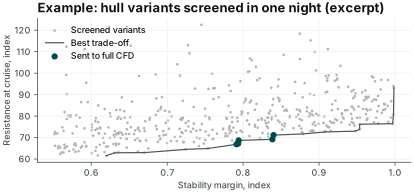
Our engineering runs on a digital platform that reads, checks and calculates around the clock. It does work a design office would never attempt by hand: thousands of hull variants in a night, every drawing checked against the rules the day it is issued, every document of your project read and compared line by line. Engineers decide; the platform makes sure nothing is missed.

Example output · illustrative, not client data
L1

Overnight hull search

Of a thousand possible hulls, which is best for you?

A parametric search over length, beam, hull spacing, deadrise and foil position. Every variant is screened for resistance, stability, weight and the CE or class limits; the best are run in full CFD.

You receive
Map of the design space, the best variants ranked, CFD of the winners.
We need
Your targets and limits: length, speed, range, berths, budget frame.
L2

Rule check of every drawing revision

Does this revision still comply?

Each revision of structure, stability and systems is checked against ISO 12215, ISO 12217, the harmonised CE standards or the class rules within a working day, with the changed items listed.

You receive
Compliance list per revision; warnings before the notified body or class sees the drawing.
We need
Drawings and models as they are issued.
L3

Contract, specification and drawing cross-check

Do the contract, the specification and the drawings say the same thing?

Every line of the build contract and specification is compared with the drawings, the equipment lists and the weight book. Contradictions, gaps and items priced twice are listed before you sign.

You receive
Discrepancy register with references to page and drawing.
We need
Contract, specification, drawings, equipment lists.
L4

Remote build monitoring

Is the yard where it says it is?

Photo and video reports from the yard are checked daily against the schedule, the drawings and the quality plan. Deviations go to the owner's representative the same day.

You receive
Daily status, weekly report, deviation log with photos.
We need
Yard reports; build schedule; access for our representative.
L5

Your yacht's digital assistant

A crew member who has read every manual.

An assistant that knows your yacht's documents — systems, manuals, maintenance plan, certificates — and answers the owner and crew in their own language, on the phone or in a chat, at any hour.

You receive
Assistant set up on your yacht's document set, updated at every refit.
We need
As-built documentation and manuals.
L6

Technical file in every language

One file, every market.

The CE technical file, owner's manual and operating instructions issued in the languages of the markets you sell in, consistent term by term.

You receive
Translated, checked document set.
We need
Approved documents in English.
L7

Broker's performance screening

Which listings tell the truth?

Claimed speed, power and range of a list of boats for sale checked against physics in one pass — before a buyer flies to see one.

You receive
Screening table with a verdict per boat.
We need
Listing data or brochures.

A · 9 services

Virtual towing tank and model tests

CFD for any hull — monohull, catamaran or trimaran. Every study is cross-checked by an independent method, and where it matters we verify it with a model test at the Bulgarian ship hydrodynamics centre in Varna, correlated with our CFD, at a fraction of the cost of Western European tanks.

Example output · illustrative, not client data
A0

Desk performance check

Do the claimed speed and range add up?

An empirical check of a seller's or designer's figures for speed, power and range.

You receive
One-page verdict with the figures we expect.
We need
Main dimensions, displacement, installed power, claimed figures.
A1-S

CFD snapshot

A fast, real CFD answer.

Bare-hull CFD at five speeds: resistance, trim and sinkage. Credited in full against a full study.

You receive
Short report with resistance curve and trim.
We need
Hull surface, displacement and LCG; speed range.
A1

Full CFD study

How will the hull perform, and why?

Three to five speeds: resistance, trim, sinkage, wave pattern and, for multihulls, interaction between the hulls; independent cross-check.

You receive
Report with charts, flow and wave images, power estimate.
We need
Hull surface; speeds; list of appendages.
A2

Additional hull variant

Which of two hulls is better?

One more hull form in the same set-up, so the comparison is like for like.

You receive
Comparison table and curves.
We need
Variant hull surface.
A3

Appendages in CFD

What do the pods, tunnels and foils cost in drag?

Resistance and flow around pods, propeller tunnels, foils and interceptors.

You receive
Appendage drag breakdown and flow images.
We need
Appendage geometry.
A4

Seakeeping

How will she behave at sea?

Motions and accelerations in the agreed sea states; bridgedeck slamming for multihulls.

You receive
Motion and comfort report.
We need
Hull surface; weights and radii of gyration; sea states.
A6

Model test campaign

A tank test anywhere, managed for you.

Test brief, model, programme, attendance, analysis and corrections to the lines.

You receive
Test report with corrected prediction.
We need
Hull lines; test wishes.
A8

Model test in Varna

Verified numbers before steel.

A model built to our lines and tested for resistance (and seakeeping on request) at the Bulgarian ship hydrodynamics centre, correlated with our CFD.

You receive
Tank report and CFD correlation.
We need
Hull lines; loading conditions.
A7

CFD, tank and trial correlation

Close the loop.

CFD, model test and sea-trial results brought together into one corrected prediction.

You receive
Correlation report.
We need
CFD, tank and trial data.

B · 7 services

Pre-design and concept

The cheapest moment to get a yacht right is before anyone draws it in detail. We turn an owner's brief into numbers, a layout and a specification the yard can price.

B1

Pre-design

What exactly are we building?

Concept, general arrangement, specification with options and packages, input data for the designer and engineers.

You receive
Concept package: GA, specification, weight and power frame.
We need
Owner's brief; use and cruising area; budget frame.
B2

Market review

What is the competition doing?

Review of the vessel type and its competitors with figures.

You receive
Benchmark report.
We need
Vessel type and size.
B3

Design-studio brief and selection

Which studio, on what terms?

Brief and scope for exterior and interior designers, short-list, licence and royalty terms.

You receive
Brief, short-list, term sheet.
We need
Owner's brief.
B4-R

Design review

Is this design sound?

A written review of lines, GA, weights and structure concept.

You receive
Review report.
We need
Lines, GA, specification.
B4

Producibility and cost review

Can it be built, and for what?

Producibility, structure weight and cost frame of a client design.

You receive
Review with structure weight and cost frame.
We need
3D model or lines; specification.
B5

Technical support for designers

Make a styling concept real.

Lines, displacement, weights, preliminary stability and powering, structural concept and class route behind a styling concept.

You receive
Naval-architecture package for the concept.
We need
Styling concept; target use.
B6

Conversion feasibility

Can this vessel become an explorer yacht?

Haul-out check, concept GA, weight and stability frame, cost frame and class route.

You receive
Feasibility report.
We need
Vessel documents; access to the vessel.

C · 11 services

Design and engineering

From approved lines to files the yard's CNC and welding shop can use — with the weight watched at every decision.

Example output · illustrative, not client data
C1

Structure and production engineering

Everything the yard needs to cut and weld.

3D structural model, working drawings, nesting, CNC files, welding plans, bill of materials and jigs.

You receive
Production pack.
We need
Approved GA and lines; scantling basis.
C2

Systems and engine rooms

Every pipe, cable and machine in its place.

Propulsion, generators, batteries, piping, HVAC, cables, switchboards, navigation and deck gear — diesel, diesel-electric or hybrid.

You receive
System diagrams, 3D layout, equipment lists.
We need
Approved GA; equipment list.
C3

Weight control

Will she float where she was drawn?

A weight book kept through the whole design; every decision checked for weight, draught and clearance.

You receive
Live weight book and monthly status.
We need
GA and equipment list.
C4

Resistance and powering

How much power?

Empirical resistance and powering.

You receive
Calculation book with charts.
We need
Main dimensions; displacement.
C5

Stability pre-assessment

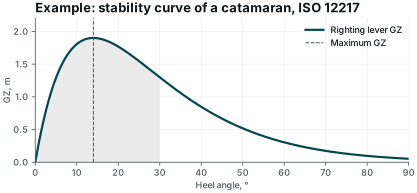
Will it pass ISO 12217?

Early stability check against ISO 12217.

You receive
Calculation book with charts.
We need
Hull surface; weights and centres.
C6

Range and fuel

How far on a tank?

Range at cruising speeds.

You receive
Range table.
We need
Power curve; tank capacities.
C7

Hull optimisation

The best hull within your limits.

Parametric hull variants, CFD of the best, recommendation.

You receive
Optimisation report.
We need
Constraints and targets.
C8

Technical procurement

The right equipment at the right price.

Specifications, enquiries and comparison of offers.

You receive
Comparison tables and recommendation.
We need
Package scope.
C9

Design management

One team, one model, one schedule.

One 3D environment, schedule and acceptance of partners' work.

You receive
Schedule, model, acceptance records.
We need
Partner contracts.
C10

Conversion engineering

From feasibility to class approval.

Structure, lengthening, stability and class submission for a conversion.

You receive
Engineering package for class.
We need
Feasibility report; drawings or 3D scan.
C12

3D laser scan and as-built model

No drawings? We measure the boat.

Laser scan by our partner, Rhino model and as-built drawings.

You receive
3D model and drawings.
We need
Access to the vessel.

K · 4 services

Working drawings for unique designs

A designer's concept is a picture. A yard needs thousands of decisions it can cut and weld. We take one-off and unusual designs — new hull forms, sculpted superstructures, unusual materials — and turn them into a complete, buildable set of working drawings without losing the designer's intent.

K1

Lines from a concept

From a render to a fair hull.

Hull and superstructure surfaces rebuilt from the designer's model or sketches, faired and checked for displacement, trim and stability.

You receive
Faired 3D surfaces and lines plan.
We need
Designer's 3D model, renders or sketches.
K2

Working drawing set

Everything the yard builds from.

Structure, superstructure, deck, outfitting and systems drawings for a one-off design, coordinated in one 3D model.

You receive
Complete working drawing set as one PDF, 3D model, CNC and nesting files.
We need
Approved concept; target rules (CE or class).
K3

Design intent review with the designer

Built as drawn — or better.

Every place where engineering changes the look is shown to the designer with options before it is fixed.

You receive
Change register with visual comparisons.
We need
Designer's contact and approval route.
K4

Unusual materials and details

Glass, curves, carbon, large openings.

Engineering of large glazing, curved panels, cantilevers, hybrid aluminium-composite details and their certification route.

You receive
Detail calculations and drawings, test plan where needed.
We need
Design details.

J · 4 services

Interior adaptation and engineering

An interior drawn on a deck plan rarely fits the real hull. We adapt interiors to the structure, weights and rules of the boat — and produce the production drawings a joinery shop can work from.

J1

Interior adaptation to the hull

Will the layout fit the real boat?

The designer's layout fitted to frames, tanks, headroom, escape routes and the CE or class requirements; options where it does not fit.

You receive
Adapted layout, clash list, options for the owner.
We need
Interior layout; GA and structure.
J2

Interior weight and material plan

Comfort without the extra tonnes.

Panel types, thicknesses and materials chosen for weight, sound and fire rules; the interior weight entered into the weight book.

You receive
Material schedule and interior weight estimate.
We need
Interior design; specification.
J3

Joinery production drawings

Ready for the joinery shop.

Furniture, linings, ceilings and floors as production drawings and cutting files, with fixing details to the structure.

You receive
Production drawings, cutting lists, CNC files.
We need
Approved interior design.
J4

Interior for an existing yacht

A new interior in an old hull.

Survey or 3D scan, new layout within the existing structure and systems, refit drawings.

You receive
Refit interior package.
We need
Access to the vessel.

D · 7 services

CE certification — hull length below 24 m

Every craft placed on the EU market needs CE marking under Directive 2013/53/EU. We prepare the complete technical file — from scantlings to the Declaration of Conformity — and coordinate the notified body where the route requires one.

Example output · illustrative, not client data
D-0

CE readiness check

How far is this boat from CE?

Gap list against the essential requirements.

You receive
Gap list with actions.
We need
Existing documentation.
D1

Structure to ISO 12215

Are the scantlings right?

Scantling calculations to ISO 12215-5, and -7 for multihulls.

You receive
Calculation for the technical file.
We need
Lines; structure drawings.
D2

Stability and buoyancy to ISO 12217

Is she stable in her category?

Calculations, test attendance and stability information.

You receive
Stability report and owner's stability information.
We need
Hull surface; weights; test date.
D3

Systems compliance

Do the systems meet the standards?

Fuel, electrical, fire protection, bilge, steering, windows and hatches, seacocks, ventilation, anchoring, man-overboard, field of vision.

You receive
Compliance drawings and checklist.
We need
System drawings; equipment list.
D4

Noise emissions

Inboard engines?

Noise assessment by test or calculation.

You receive
Noise report.
We need
Engine data.
D5

Owner's manual, HIN and plate

What the owner receives.

Owner's manual to ISO 10240, hull identification number, builder's plate.

You receive
Manual and plate drawing.
We need
Equipment manuals.
D6

Technical file and Declaration of Conformity

The file that puts the boat on the market.

The conformity route by design category and length, the technical file and notified-body coordination.

You receive
Technical file and Declaration of Conformity.
We need
D1–D5 complete.

E · 7 services

Class and flag — 24 m and above

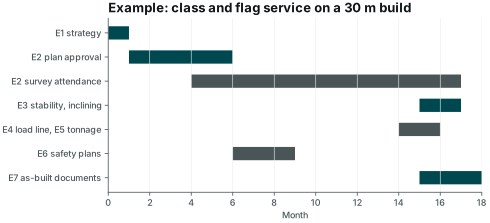
From 24 m the yacht is built under class and registered under a flag. We run the whole process: strategy, plan approval, surveys and the statutory documents.

Example programme · durations depend on scope and inputs
E1

Class, flag and code strategy

Which society, notation and flag?

Society, notation, flag, private or commercial use and the applicable codes.

You receive
Strategy memo.
We need
Use and cruising area.
E2

Plan approval and surveys

Drawings approved, surveys passed.

Submissions, comments closed, survey attendance through design and build.

You receive
Approved drawings, survey records.
We need
Drawings.
E3

Stability booklet and inclining

The stability booklet class and flag sign.

Intact and damage stability booklet with inclining test.

You receive
Approved booklet.
We need
Hull surface; inclining date.
E4

Load line and freeboard

Load line and freeboard documents.

You receive
Documents for assignment.
We need
GA, lines.
E5

Tonnage measurement

Support for tonnage measurement.

You receive
Tonnage calculation.
We need
GA, lines.
E6

Safety and pollution prevention plans

Pollution prevention, fire control and safety plans.

You receive
Approved plans.
We need
GA, systems.
E7

As-built documentation

As-built documentation and operating manuals for class and flag.

You receive
Document set.
We need
As-built data.

F · 6 services

Flag, registration and commercial use

Registration under construction or on delivery, and the compliance a yacht needs for charter. Any length.

F1

Flag advice and registration

Which flag, and how?

Flag and regime advice, registration on delivery.

You receive
Registration file.
We need
Owner documents.
F2

Registration under construction

Title secured from the first stage.

Registration of the vessel while it is being built.

You receive
Registration.
We need
Build contract; owner documents.
F3

Charter compliance

Ready for paying guests.

Fire safety, life-saving appliances, minimum crew; REG Yacht Code from 24 m.

You receive
Compliance package.
We need
GA; equipment list.
F4

Under-24 m optimisation

More yacht below the 24 m line.

Rule length and tonnage designed in from the start.

You receive
Design guidance.
We need
Lines.
F5

Equivalence case

When the rule does not fit the idea.

Direct calculation, FEM or tests to prove equivalence to the notified body or class.

You receive
Equivalence case.
We need
Design to be justified.
F6

Lightship survey

What does she really weigh?

Lightship survey and weight audit.

You receive
Survey report.
We need
Access to the vessel.

M · 4 services

Building and build management

We do not only design. We build in the EU with our own team and manage the build for the owner: one contract, one schedule, one budget, one team responsible from the first plate to delivery.

M1

Yard selection and build contract

Which yard, on what terms?

Tender to yards, comparison of offers, build contract with stage payments tied to physical milestones and warranty terms.

You receive
Tender package, offer comparison, contract ready for signature.
We need
Specification and drawings.
M2

Hull or complete yacht built by us

One counterparty for the whole build.

We contract the build and deliver the hull or the complete yacht, built by our team with our engineering and our supervision.

You receive
Hull or yacht to the contract specification.
We need
Approved design; build contract.
M3

Build management

Schedule, budget and quality under one hand.

Planning, suppliers, cost control, quality plan, inspections and the change log; biweekly reports to the owner.

You receive
Schedule, budget reports, quality records, change log.
We need
Build contract; specification.
M4

Delivery and handover

From sea trials to the owner's first voyage.

Trials, defect closure, certificates, crew familiarisation and handover documentation.

You receive
Delivery file and handover protocol.

G · 13 services

Supervision and after-sales

We represent the owner at any yard, check the work on site, run the trials — and stay with the yacht after delivery.

G4

Owner's representative

Your eyes at the yard.

New-build supervision against the contract and specification, with biweekly reports.

You receive
Reports, defect lists, stage acceptance.
We need
Build contract; schedule.
G3

Turnkey procurement

Purchasing of equipment for the build.

You receive
Orders and delivery tracking.
We need
Purchase list.
G5

Refit and conversion management

Project management of a refit or conversion.

You receive
Schedule, reports, acceptance.
We need
Scope.
G6

Acceptance and sea trials

Does she do what was promised?

Trial programme, attendance, measurements and defect list.

You receive
Trial report.
We need
Contract specification.
G7

Shipbuilding contract review

Technical review of a build contract.

You receive
Report with redlines.
We need
Draft contract.
G8

Technical and condition survey

Before you buy.

Condition survey anywhere, abroad with a local partner surveyor.

You receive
Survey report.
We need
Access to the vessel; papers.
G9

Weld inspection

Independent visual and ultrasonic weld inspection.

You receive
Inspection report.
We need
Schedule.
G10

Commissioning and design supervision

Installation, commissioning and design supervision on site.

You receive
Commissioning records.
We need
Schedule.
G11

Owner and investor report

A monthly report on progress, money and risk.

You receive
Monthly report.
G12

Series package

Hull no. 2 onwards.

Engineering update for each further hull of a series.

You receive
Updated pack.
G13

Model book for shows and brokers

Model book and sales material for shows and brokers.

You receive
Model book.
We need
Model data, renders.
G14

Owner support

Documentation, warranty, spares and service-yard support after delivery.

You receive
Monthly support.
G15

Budget and stage payment schedule

Design-chain budget and stage payment schedule for a project.

You receive
Budget and schedule.
We need
Partner quotations.

Certification by hull length

Below 24 m and above

What a new yacht needs before it can be sold or registered, and what we deliver for it.

Below 24 m — CE marking24 m and above — class and flag
Legal basisRecreational Craft Directive 2013/53/EU, hull length 2.5–24 mClass society rules and the flag state; Load Line and Tonnage conventions from 24 m load line length; REG Yacht Code Part A for commercial yachts up to 12 passengers
RouteSet by design category and length: modules A, A1, B+C/D/E/F, G or H. From 12 m in categories A–C a notified body takes partClass plan approval and surveys during construction, flag registration, statutory certificates as applicable
Our serviceD1 structure, D2 stability with tests, D3 systems, D4 noise (inboard craft), D5 owner's manual, HIN and plate, D6 technical file and Declaration of ConformityE1 strategy, E2 plan approval and surveys, E3 stability booklet with inclining, E4 load line, E5 tonnage, E6 safety and pollution plans, E7 as-built documentation
Charter useF3 commercial compliance packageF3 REG Yacht Code package

Hull length is measured to ISO 8666. Load line length is a different measure: a yacht can exceed 24 m overall and still stay below 24 m load line length (F4).

How we work

Fixed fee, in writing, the same day

Quotation
Fixed fee per service, in writing, the same working day. Binding once the two-page order is signed.
Payment
Fixed-fee services: half with the order, half on delivery. Monthly services in advance.
Start
Lead times run from the deposit and the inputs listed for each service; we confirm the start date in writing.
Deliverables
Reports, calculations and drawings as PDF by secure link; 3D models in the agreed format.
At cost
Notified-body, class, flag and registry fees; towing tank and model; cloud computing; surveyors abroad; travel.
Your data
Your drawings and results are used only for your project. Our own hull technologies are discussed under a mutual NDA.

Get in touch

Let's build

01 · Investor

A technical survey of the site and a legal review of the concession. We arrange both and open the data room under NDA.

02 · Owner

Send the brief, or the design you already own. You get a producibility check and a quote per stage, on an open book.

03 · Brand

Send the 3D model, class drawings and specification. You get a producibility report and a scope you set yourself.

Or simply write to sales@stingray-yachts.com. Your details go only to the Stingray team — see the privacy policy.

Correspondence runs through sales@stingray-yachts.com. Hours, material invoices and subcontract orders on a build are visible to you online as they happen.