Journal · Neurodesign
Neuroergonomics of Luxury
A custom yacht for tens of millions of euros does not guarantee peace of mind on board. Why interiors designed like city penthouses fail at sea — and what neurodesign does instead.
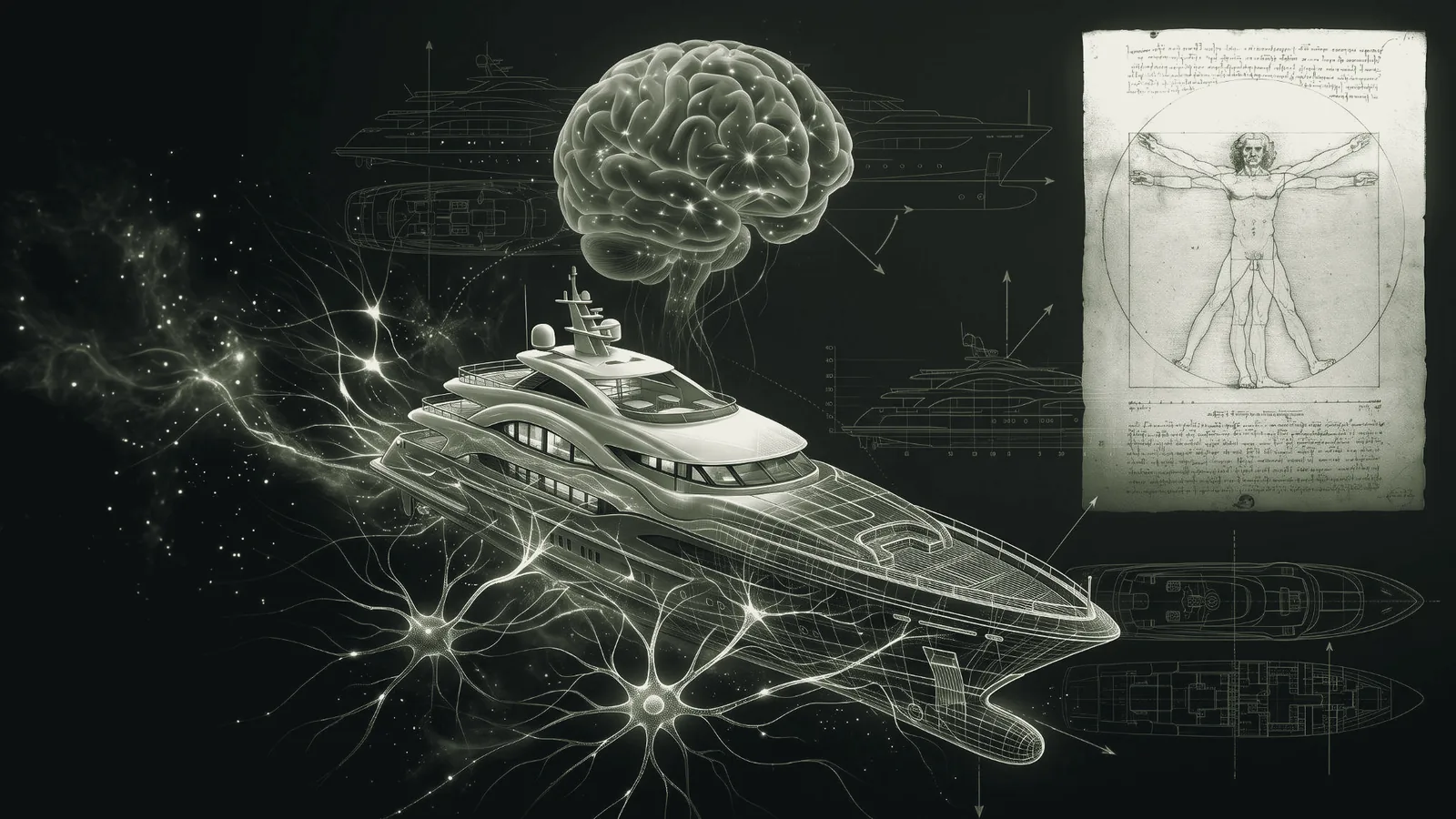
“Real luxury at sea is a physiological resource.”
- The industry paradox: a custom yacht costing tens of millions of euros does not guarantee peace of mind on board.
- Why most yacht interiors are designed like city penthouses — and why that logic fails at sea.
- From outward, ceremonial wealth to brain chemistry and neuroergonomics.
Welcome to this page.
If you are used to designers’ blogs with “this season’s trends” and glossy renders, make yourself comfortable — this will be something quite different.
I have twenty-two years of interior design behind me and hundreds of completed projects. But my design works by different rules.
My career has always run in two opposite worlds at once. On land I designed country residences, penthouses and private clinics; on the water, the hard, all-consuming work on the interiors of private yachts and catamarans.
Somewhere around my fifteenth year in practice I realised I had hit the ceiling of classical design. Forms, styles, light, junction details — all of it had become automatic. Going further into pure decoration was boring. I wanted to rethink the profession from the ground up: to understand how the spaces I create govern a person’s body chemistry and mind, and to learn to design interiors that protect rather than merely decorate.
For that answer I did not go to a decorators’ course. I went to university, for a master’s degree in psychology specialising in cognitive ergonomics.
Once you start looking at space through psychophysiology, the familiar glossy world of design falls apart. Especially on the water, where every millimetre of error is multiplied by the laws of the sea. My double experience — on land and at sea — exposed the central truth: what feels luxurious and ergonomic in a static country villa turns, on board, into a source of quiet, exhausting stress for the brain.
I design interiors where hard engineering, aesthetics and cognitive science meet. Today I want to talk about what the glossy yard catalogues stubbornly leave out — the first and most insidious enemy of comfort on the water: neurological conflict.
The anatomy of neurological conflict at sea
Someone who spends tens of millions of euros on a custom yacht expects a perfect space for recovery and full control over their life. But the moment the boat leaves the berth, physiology takes over — and physiology cares nothing for the owner’s status or the price of the sofa.
The sopite syndrome
Most people are sure that if they are not sick on a boat, seasickness has passed them by. That is a dangerous mistake.
As early as 1976, Ashton Graybiel and Joseph Knepton of the US Naval Aerospace Medical Research Laboratory in Pensacola described a phenomenon they named the sopite syndrome, from the Latin sopire, “to put to sleep”.
Graybiel and Knepton showed that motion causes a specific neurological response, separate from classic nausea. The stomach is fine, but the person develops symptoms usually blamed on jet lag, overwork or age:
- persistent apathy and a dull, background heaviness in the head;
- unexplained irritability and emotional ups and downs;
- fragmented sleep: eight hours in bed, and you still wake up shattered;
- a noticeable drop in working memory, attention and speed of decision-making.
As a psychologist I often see people try to compensate with spa treatments or alcohol. But the problem is not in the muscles or the mood. It is a background exhaustion of the central nervous system.
Sensory dissonance: metabolic wear on the nervous system
Why does it happen? Neuroscience explains it with the sensory conflict theory set out by the British researchers James Reason and Joseph Brand in their classic Motion Sickness (1975).
Every second, our brain assembles a picture of the world from three main sources:
- The vestibular system — the otoliths and semicircular canals of the inner ear — registers even the smallest accelerations, heel and roll.
- Proprioceptors — receptors in our muscles and joints — continuously adjust muscle tone so that we keep our balance.
- Vision looks at the cabin walls and reports: “All stable, we are in a room, the walls are straight, the floor is still.”
The result is a hard mismatch. The vestibular system and the muscles signal “We are moving!”, while the eyes insist “We are standing still!”
To resolve the dissonance, the cerebellum and the cortex start what neuroscientists call sensory reweighting: the brain forcibly turns some signals down and others up. Professor Thomas Stoffregen of the University of Minnesota’s kinesiology laboratory has spent years studying how people adapt to life at sea. His work shows that on a vessel the body spends resources continuously just on postural control — on keeping its balance — and that balancing on an unstable surface stops being a background, unconscious process.
Processing contradictory information and controlling the motor system cost the nervous system a great deal of glucose and oxygen. On a yacht your brain runs like an overheated processor at full power while you are simply reading a book in your cabin. The result is deep neurological fatigue that catches up with people by the end of the second day.
Micro-vibration and a broken body clock
Two more factors add to the sensory conflict, and interior designers without a background in psychology routinely ignore both.
- Low-frequency background (1–20 Hz). Diesel generators and waves striking the hull create low-frequency vibration. You may not hear it, but the body’s mechanoreceptors register it. Maritime health researchers link long exposure to vibration on board with load on the stress axis — the system through which the body releases cortisol. The body can stay in a background state of fight-or-flight even while you rest.
- Disrupted circadian rhythms. On the lower deck, where master cabins are usually placed, there is no natural horizon and a severe shortage of the right light spectrum. As Harvard neuroscientist Steven Lockley, an expert on light and circadian rhythms, has shown, too little short-wavelength “blue” light in the morning and too much bright artificial light in the evening suppress melatonin. After a couple of days in a closed cabin, deep (slow-wave) sleep can be cut back sharply.
An interior designed without regard to these biochemical and psychological processes becomes a beautiful, extremely expensive and utterly unliveable space that quietly drains its owner.
Geometric stress: why dry minimalism turns hostile at sea
In architecture on land, the right angle is the ultimate symbol of stability, order and human control over chaos. We like the flawless parallels of penthouses, monolithic cubic consoles and floating cabinets. But move the same geometric code into a yacht interior, and the brain starts reading it as a signal of hidden threat.
The cognitive psychology of spatial perception has an important rule: an interior does not exist apart from the physics of its environment. On land the walls are still and the gravity vector never changes. At sea, even a perfect calm brings constant micro-motion, which turns an architecture of hard lines into a source of so-called geometric stress.
The sharp corner as a potential projectile
Our brain evolved in a natural world without sharp man-made edges. Neuroscientists Moshe Bar and Maital Neta at Harvard showed that objects with sharp angles activate the amygdala — the ancient structure of the brain that processes fear and recognises threats — more strongly than rounded ones. Anjan Chatterjee, professor of neuroaesthetics at the University of Pennsylvania, discusses reactions of this kind in The Aesthetic Brain. On land we easily overrule the impulse with logic: “The table isn’t going anywhere; I’ll just walk past it.”
On a moving deck, that self-control breaks down.
Thomas Stoffregen, mentioned above, studies postural control on unstable surfaces. His work leads to a simple conclusion for a designer: in a seaway, the nervous system stops treating nearby rigid objects as furniture and starts treating them as physical obstacles and potential causes of injury.
In a minimalist cabin with islands of rectangular solid wood, the brain assesses those corners around the clock: “If a wave comes now, that perfect edge will hit me in the temple or the ribs.” In a space made for rest, the subconscious stays in constant muscular and emotional tension.
The illusion of a falling world
The second problem with land geometry at sea is the absolute vertical.
The right angle depends on the wall being strictly perpendicular to the floor. But underway or at anchor a vessel heels all the time, and a sharp visual-vestibular conflict appears. Your inner ear knows exactly where true gravitational vertical is. Your eyes, meanwhile, rest on the perfect line of a wall or a cabinet that has tilted with the hull by five to seven degrees.
Colin Ellard, who studies the perception of space and leads the Urban Realities Laboratory at the University of Waterloo, shows in Places of the Heart how strongly our well-being depends on whether the geometry around us matches what the body expects. On a yacht this becomes literal. Every departure of strict forms from gravitational vertical makes the brain perform laborious corrections. The right angle cannot forgive a tilt: the brain reads a tilted vertical not as “the boat rolled”, but as “the room is collapsing”.
When walls and furniture have soft, organic radii that flow into one another, the brain easily ignores small angles of heel: the eye has no hard reference to catch on and measure the departure from vertical. Surrounded by strict cubic minimalism, the visual system tires itself out with constant calculation.
Nothing to hold on to: the unprotected body
Land minimalism loves floating furniture, long smooth surfaces without detail and no “visual noise”. In a penthouse that feels airy. On a yacht it becomes an ergonomic disaster.
The cognitive ergonomics researcher Don Norman, author of The Design of Everyday Things, brought the idea of affordances into design: the way the shape of an object tells us how to use it.
On a moving yacht people need physical and visual points of grip — concealed handrails, fiddles on worktops, recesses in the walls. If a minimalist interior gives these up for the sake of a “clean line”, the brain registers the absence of safety affordances. When the motion builds, people find themselves in a space with literally nothing to hold on to without hurting their fingers on smooth polished panels.
That is why land minimalism turns a cabin at sea into a beautiful but psychologically aggressive bunker. Next: how we use neurodesign and biophilia to correct these mistakes and soothe an unsettled mind.
Neurodesign and biophilia: giving the mind back its sense of safety at sea
Once we understand how the human nervous system works on a moving vessel, the approach to design changes fundamentally. The task of a modern marine designer is not to copy a fashionable Milan catalogue, but to build a biomechanical and psycho-emotional buffer for the nervous system.
This is where neurodesign, biophilia and cognitive ergonomics come in. They let us, quite literally, come to terms with the ancient structures of the brain and give people what they came aboard for: deep recovery.
Soft edges and organic curvature
The first step against geometric stress is to give up hard corners in favour of radiused junctions and gentle micro-curves. In neurodesign this approach is known as soft-edge architecture.
The neuroscientist Semir Zeki, a founder of neuroaesthetics at University College London, shows in his research how differently the brain responds to different forms. Smooth, curved lines are associated with natural things — living bodies, waves, treetops — and read as a safe environment.
In a yacht interior we specify radii of at least 30–50 mm on all projecting furniture, bulkheads and ceiling recesses. When the hull heels, a smooth curve blurs the line between wall and ceiling. The eye has no hard reference to register the departure from vertical. The sensory conflict quietens, and the amygdala stops producing signals of background alarm.
Tactile engineering and matt textures
In a seaway the brain looks for confirmation of safety not only through the eyes but through touch.
The gloss of the land — perfectly polished marble and lacquered veneer — works against us on a yacht. First, in motion, glossy surfaces catch moving reflections of the lights that flicker like a strobe and tire the retina. Second, the brain associates gloss with slipperiness.
We apply the idea of tactile grounding:
- Matt, porous surfaces: deeply brushed veneer, unfilled travertine, micro-cement, textured fabrics such as bouclé, hopsack and linen.
- “Warm” materials: hand-finished leather on handrails, woven rattan, natural wool.
The architect and phenomenologist Juhani Pallasmaa writes in The Thinking Hand that touch is the oldest foundation of our sense of reality: the eye trusts what the hand has touched. In an unstable world, a matt, textured surface gives the nervous system a sense of a physical anchor.
Touching brushed wood or a leather handrail, a person gets instant feedback: “This surface is reliable; my hand won’t slip.”
Lighting engineering (HCL) and circadian hygiene
As I mentioned, one of the main causes of the sopite syndrome on a yacht is a disrupted body clock, caused by the lack of the right light in lower-deck cabins.
To solve this, we integrate human-centric lighting (HCL).
Russell Foster, professor of circadian neuroscience at the University of Oxford and one of the discoverers of the light-sensitive ganglion cells of the retina (ipRGCs), showed that our internal clocks are set by the changing quality of daylight. In a closed space without that change the circadian rhythm drifts, and sleep and mood follow.
We programme the yacht’s lighting scenes to follow the rhythm of the day where she is cruising:
- Morning: the cabin fills with intense light rich in the blue part of the spectrum. This switches off melatonin production and helps the brain wake up easily.
- Day: neutral daylight.
- Evening: blue light is cut automatically, and concealed niche lighting comes on in an amber, sunset tone (1800–2200 K).
We also use reflected low light. Fittings set into furniture plinths right at floor level visually “ground” the cabin and give the brain the centre of gravity it needs.
Virtual horizons and biophilic fractals
Deep inside the hull, without a view of the sea, the brain feels a background sense of confinement. To lift that barrier we use biophilic technologies:
- Architectural light wells and optical systems such as CoeLux. They imitate a sunbeam passing through the atmosphere and reproduce the depth of a real sky on the cabin ceiling.
- Natural fractals in the décor. Research by the physicist Richard Taylor at the University of Oregon showed that looking at natural fractals — self-similar patterns such as the grain of wood, veining in marble or the pattern of sea foam — with a fractal dimension of D = 1.3–1.5 reduces physiological stress by up to 60 %.
A new measure of luxury
After twenty-two years of practice and years of studying psychophysiology, I have come to one firm conclusion.
Real luxury on a modern superyacht is no longer measured in carats of gold leaf, in rare marbles or in how closely a cabin resembles a Victorian country house.
Real luxury at sea is a physiological resource: the ability of a space to act as a quiet, intelligent buffer between a person and the constantly moving sea.
When we remove geometric stress, replace aggressive minimalism with organic radii, build the right rhythm of light and damp out micro-vibration, something remarkable happens. The crew stop seeming irritating, the headaches go, and for the first time in years the owner wakes up in the master cabin with a clear head and a sense of deep calm.
That is what neurodesign is for: so that you command the sea, rather than your nervous system paying for it in wear.
About the author
Natalia Dmitrienko — lead interior designer at Stingray Lab, working where marine engineering meets cognitive psychology. Twenty-two years of interior design on land and on the water; master’s degree in psychology, specialising in cognitive ergonomics.
Sources
- Graybiel, A., & Knepton, J. (1976). Sopite syndrome: a sometimes sole manifestation of motion sickness. Aviation, Space, and Environmental Medicine, 47(8), 873–882.
- Reason, J. T., & Brand, J. J. (1975). Motion Sickness. London: Academic Press.
- Riccio, G. E., & Stoffregen, T. A. (1991). An ecological theory of motion sickness and postural instability. Ecological Psychology, 3(3), 195–240.
- Stoffregen, T. A., & Smart, L. J. (1998). Postural instability precedes motion sickness. Brain Research Bulletin, 47(5), 437–448.
- Bar, M., & Neta, M. (2007). Visual elements of subjective preference modulate amygdala activation. Neuropsychologia, 45(10), 2191–2200.
- Chatterjee, A. (2014). The Aesthetic Brain: How We Evolved to Desire Beauty and Enjoy Art. New York: Oxford University Press.
- Ellard, C. (2015). Places of the Heart: The Psychogeography of Everyday Life. New York: Bellevue Literary Press.
- Norman, D. A. (2013). The Design of Everyday Things: Revised and Expanded Edition. New York: Basic Books.
- Zeki, S. (1999). Inner Vision: An Exploration of Art and the Brain. Oxford: Oxford University Press.
- Pallasmaa, J. (2009). The Thinking Hand: Existential and Embodied Wisdom in Architecture. Chichester: John Wiley & Sons.
- Taylor, R. P. (2006). Reduction of physiological stress using fractal art and architecture. Leonardo, 39(3), 245–251.
- Lockley, S. W., Evans, E. E., Scheer, F. A., Brainard, G. C., Czeisler, C. A., & Aeschbach, D. (2006). Short-wavelength sensitivity for the direct effects of light on alertness, vigilance, and the waking electroencephalogram in humans. Sleep, 29(2), 161–168.
- Foster, R. G., & Kreitzman, L. (2004). Rhythms of Life: The Biological Clocks that Control the Daily Lives of Every Living Thing. New Haven: Yale University Press.
- Jensen, A., & Jepsen, J. R. (2014). Vibrations and health effects at sea. International Maritime Health, 65(3), 173.
An interior that does notfight the sea
We adapt yacht interiors to the real structure, weights and rules of the boat — and to how people feel on board.