Power catamaran · centre console

STINGFIN 6

Six metres, a flush deck with no sills from bow to transom, and 2.44 m of beam — inside the European road limit and inside the stricter German one.

6.30 mLength overall
2.44 mBeam overall
CDesign category
4Persons
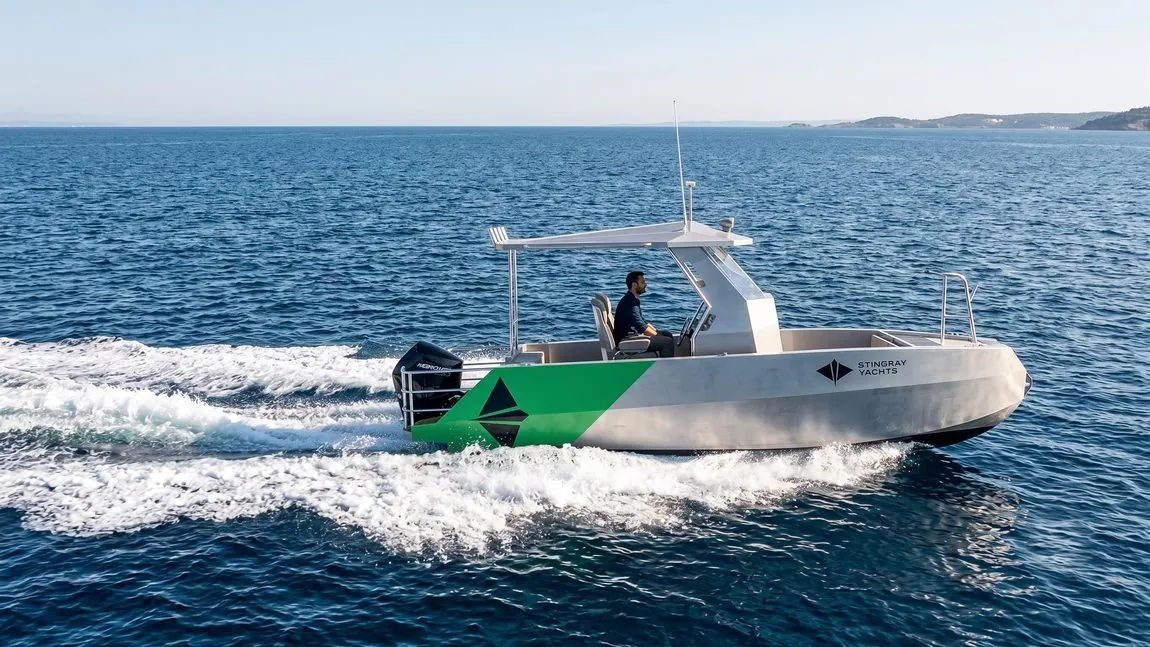
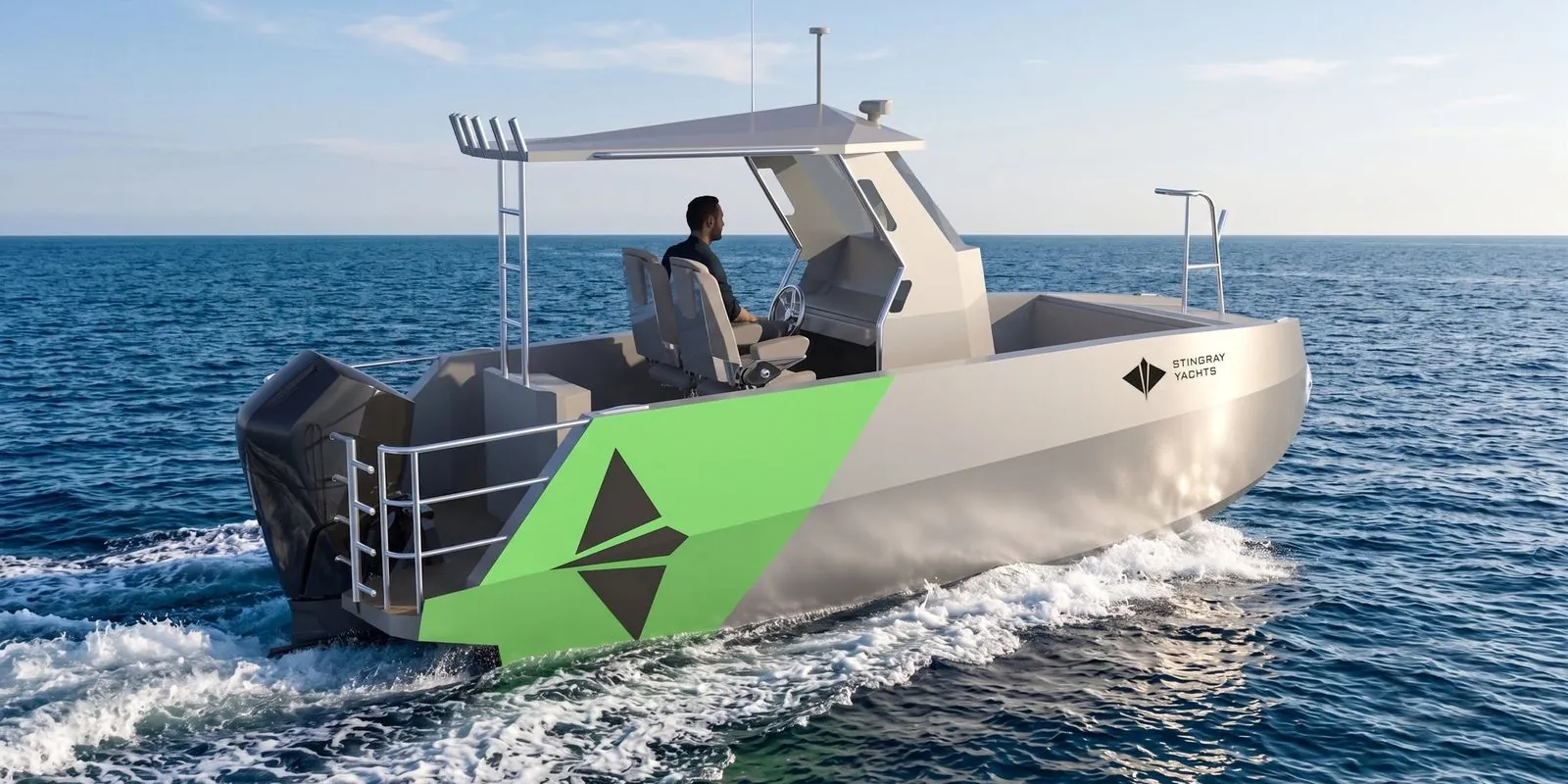
STINGFIN 6 under way, starboard bow quarter — hardtop over the centre console, the walk-around deck and the twin-hull transom

01The boat

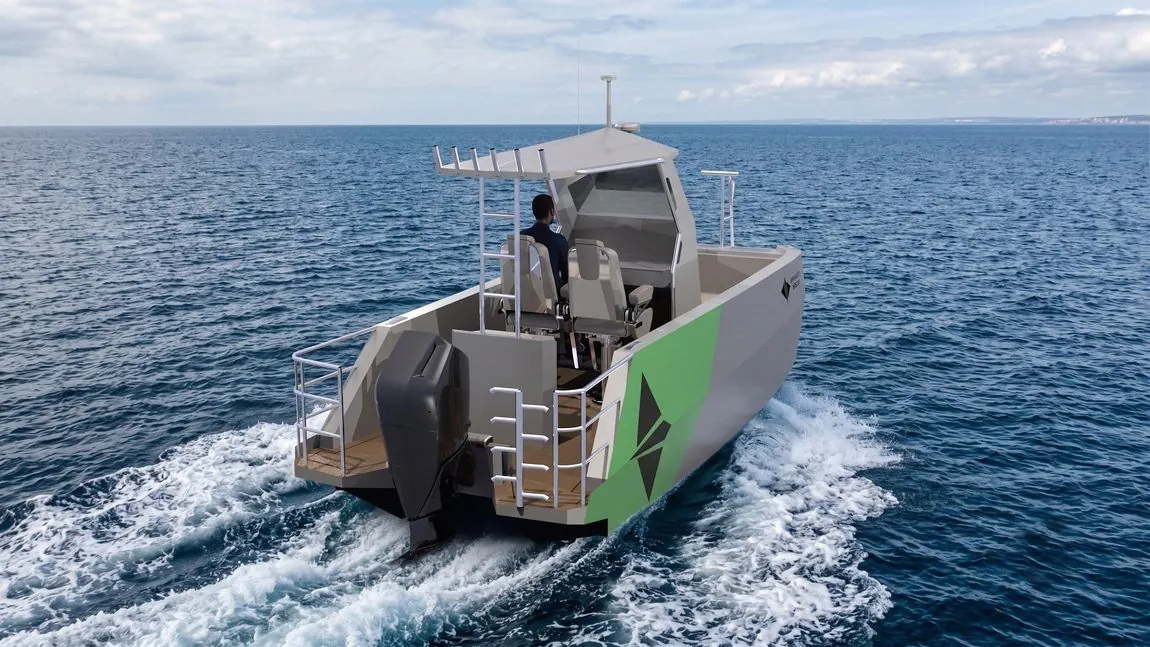
STINGFIN 6 is a 6.3-metre welded aluminium catamaran — two hard-chine demihulls joined by a bridgedeck, carrying a flush working deck that runs from transom to bow with no sills at all. The engine sits on the centreline, which leaves both sides of the boat free.

A monohull of this length cannot offer that deck. It is the reason the boat exists: room to work, fish or dive on a hull short enough to keep at home.

Between the hulls the tunnel roof is veed rather than flat. A flat roof sat below the full-load waterline across its whole width, so the wet deck slammed at rest; raising the apex 200 mm puts it 128 mm clear of the water and squeezes the crest of the tunnel wave sideways up the vee instead of meeting it head-on. The flats still run under the waterline and are designed as bottom, which is what the geometry requires.

At 2 440 mm she sits inside the 2 550 mm European road limit and inside the stricter German 2 500 mm, with no oversize permit. She is designed to CE Category C for four people on a single 150 hp outboard, with the transom and the engine foundation rated for 200 hp as standard.

Every figure on this page is computed from the hull geometry measured off the 3D model, not scaled from a similar boat. What is calculated rather than measured is marked as such.
02What defines her

Flush deck

No sills, bow to transom

A continuous working deck across the bridgedeck and both demihulls, walkable on both sides, with the engine on the centreline instead of in the way. No step down into a cockpit anywhere. Sealed lockers in the demihulls, bottom damping and closed-cell foam under the decking.

Folded, not faired

Bare satin aluminium

CNC-cut and folded to the ORIGAMI geometry, then welded: 4 mm bottom in 5083, 3 mm topsides in 5086, 4 mm deck, 3 mm on the veed tunnel roof, which is designed as bottom. The folded panel carries a 5.02 mm skin on a 200 mm rib pitch against the 3.6 mm the standard asks for at the 28 kn design point — a margin of 1.4. No fairing and no paint above the waterline; epoxy primer and antifouling below.

Road legal

Trailerable without a permit

2 440 mm of beam against a 2 550 mm limit, and inside the stricter German 2 500 mm. Boat and trailer make a combination near 4.5 tonnes, which needs a twin-axle braked trailer from 2 800 kg, a tow vehicle rated for 2 600 kg or more and a category BE licence — but no oversize permit and no escort.

03Renders

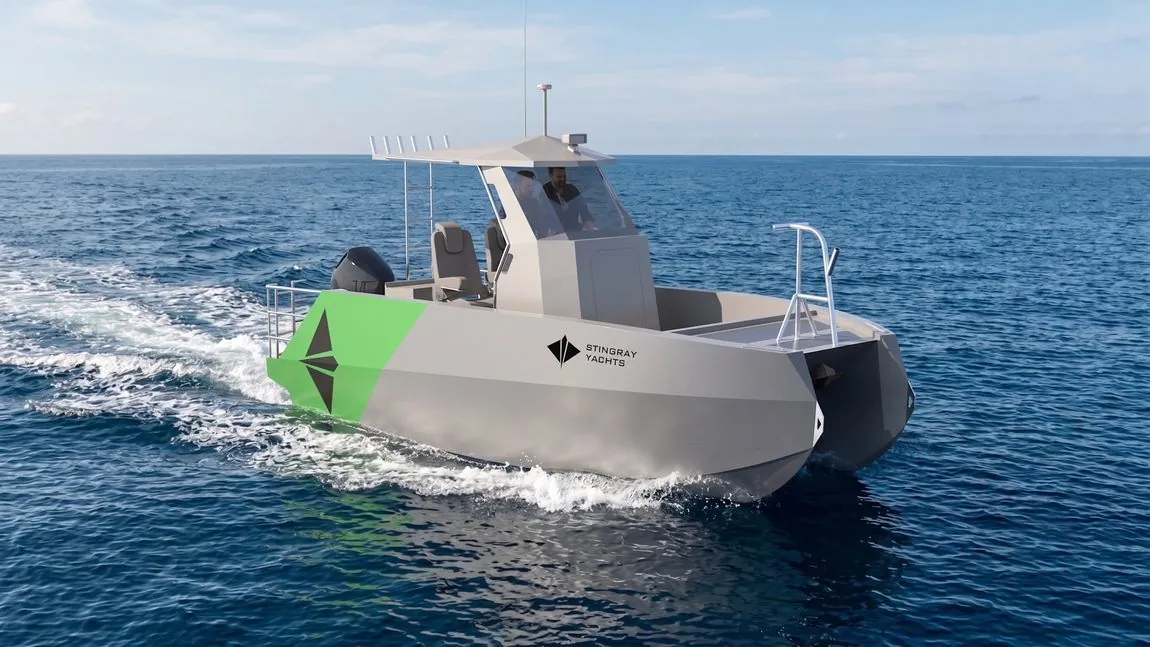
Astern — the transom and the space between the demihulls. The engine is on the centreline, so both quarters stay clear for working and boarding
Port beam — sheer, freeboard and the flush deck line running unbroken from transom to bow
Bow quarter — entry, flare and the walk-around side deck. The console sits far enough aft to leave a working foredeck
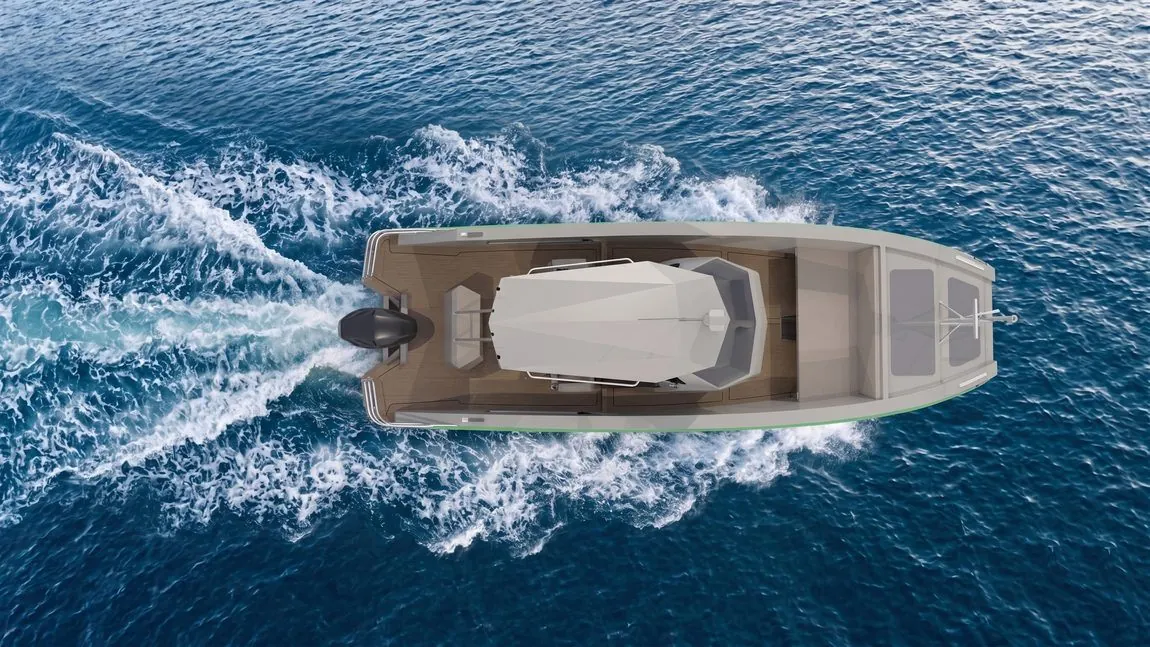
Plan — the flush deck from above. No sills, no step down into a cockpit: the whole deck is one level

04Drawings

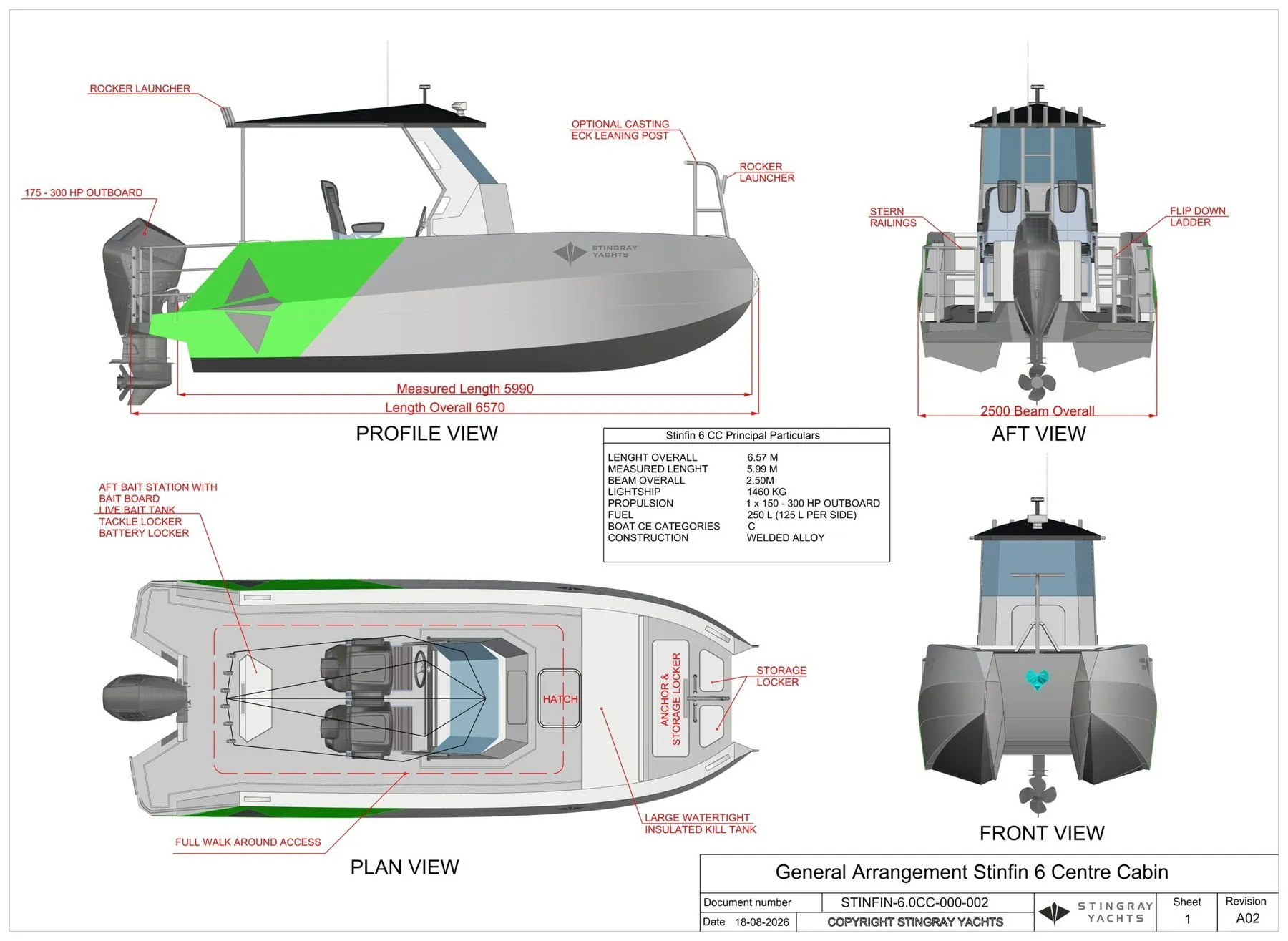
General arrangement, STINGFIN 6 Centre Cabin — drawing STINFIN-6.0CC-000-002, sheet 1, rev A02 of 18 August 2026. The drawing predates the design decisions of 3 and 4 September and still carries the earlier beam, light ship and fuel figures; the specification above governs

05Standard specification

Everything here is included in the base boat.

Hull & finish

Structure
Welded aluminium catamaran, two hard-chine demihulls on a bridgedeck; CNC-folded plate (ORIGAMI), transverse framing
Plating
Bottom 5083 4 mm, topsides 5086 3 mm, deck and platform 4 mm, console and superstructure 5086 3 mm, veed tunnel roof 5083 3 mm
Framing
Omega 75 mm transverse frames on an 800 / 900 mm grid — one grid on every hull, whatever engine is fitted
Design stresses
As-welded properties throughout: 165 N/mm² bottom, 144 N/mm² topsides, 87.5 N/mm² framing
Finish
Bare satin aluminium — no fairing, no paint
Below waterline
Epoxy primer and antifouling

Hull form

Waterline length
5.60 m at full load, 5.50 m light
Chine beam per demihull
560 mm at 0.4 LWL, measured on the hull model
Deadrise
18.4° at 0.4 LWL
Clear tunnel width
1 156 mm, demihull keel to demihull keel
Hull separation
1 394 mm between centres of buoyancy at the design mass
Tunnel roof
Veed — flats 363 mm above the keel, apex 563 mm; the apex stands 128 mm clear of the full-load waterline
Draft
345 mm light ship, 434 mm at full load

Weight & stability

Light ship
1 521 kg
Full load, design mass
2 219 kg — the mass the structure and the stability are calculated to
GM
1.48 m at the design mass, 2.10 m light, against the 0.35 to 0.50 m a boat this size needs
Roll period
1.3 to 1.6 s — stiff, as a catamaran is
Heel, four persons one side
4.4° against a 10° limit; 8.7° combined with wind at 17 m/s

Propulsion

Engine
One 150 hp outboard, 25 in transom
Transom
Rated for 200 hp as standard — an 8 mm doubler gives 480 cm³ against the 80 cm³ required
Steering
Hydraulic
Fuel
2 × 100 L, tanks in the demihulls

Performance

Maximum speed
30.3 kn at the design mass on 150 hp — carried in the specification as 28–30 kn at full load
Cruise
24 kn, about 99 hp required
Range at cruise
136 nm at 24 kn on 200 L with a 10 % reserve
With the engine options
33.2 kn at 175 hp, 35.9 kn at 200 hp
Basis
Savitsky per demihull and doubled, 9 % appendage allowance, 0.60 propulsive efficiency, consumption at 0.32 L per horsepower-hour. To be confirmed on sea trials

Electrical

Batteries
Single battery with isolator
Bilge
Two automatic pumps, one per demihull — the compartments are not interconnected
Lighting
Navigation and deck lighting

Deck, helm & safety

Deck
Flush, no sills from bow to transom, both sides walkable
Decking
Cork or EVA in the cockpit
Acoustics
Bottom damping, closed-cell foam under the decking
Stowage
Sealed lockers in the demihulls
Seating
Bench and two seats
Deck hardware
Rails, cleats, anchor locker; bathing ladder integrated into the demihull transom
Helm
Engine instruments as supplied; plotter preparation and a location and power for a VHF set
Safety
Full CE category C safety pack

Certification & transport

Design category
C — significant wave height to 2 m, wind to Beaufort 6, kDC 0.6
Route to CE
Module A, internal production control under the Recreational Craft Directive. At this hull length a notified body is not required, provided the harmonised standards are applied
Standards
EN ISO 12215-5 and ISO 12215-7 for scantlings, EN ISO 12217-1 for stability and buoyancy, ISO 14946 for load capacity, ISO 11592-1 for maximum power
Status
A design target, not a certified result: the technical file, the builder’s plate, the owner’s manual and the inclining experiment all belong to hull no. 1
Road transport
2 440 mm wide against the 2 550 mm EU limit and the stricter German 2 500 mm — no oversize permit. Twin-axle braked trailer from 2 800 kg, tow vehicle rated 2 600 kg or more, category BE licence
Crane lifting
About 12.9 kN per point on four pad-eyes welded into floors and bulkheads, never into plating

06Options

The base boat is lean on purpose. Options are quoted on request.

Propulsion

  • 175 hp outboard — 33.2 kn
  • 200 hp outboard — 35.9 kn
  • Interceptor trim control

Exterior

  • Full fairing and paint
  • Bimini or sun awning over the console

Interior & comfort

  • Convertible furniture — settee, removable table, cushions
  • Shower and second ladder, 20 L
  • Cockpit shower with hot water

Helm & electrical

  • Chartplotter, 9–10 in
  • VHF set with antenna
  • Second battery with charger

Fishing

  • Bait station
  • Live-bait tank
  • Kill tank
  • Rocket launchers

Transport & handover

  • Braked road trailer
  • Mooring pack — fenders and lines
  • Delivery and commissioning at your marina

07Build & certification

STINGFIN 6 is built at the Stingray yard in Burgas, Bulgaria. Scantlings are calculated to EN ISO 12215-5 on as-welded material properties at the 2 219 kg design mass, with the chine beam and the deadrise measured from the hull model rather than assumed, and the option speeds checked as design speeds in their own right. For a category C craft of this hull length the Recreational Craft Directive allows Module A — internal production control, with no notified body — provided the harmonised standards are applied, and that is the route. The technical file, the declaration of conformity, the craft identification number, the builder’s plate and the inclining experiment all belong to hull no. 1.

TypePower catamaran, centre console
YardStingray Yachts, Burgas, Bulgaria
MaterialMarine aluminium, unpainted
Design categoryC
Persons4
TransportTrailerable, no permit

Speed, range and stability are calculated, not measured. The demihulls are slender and run semi-planing, so the Savitsky prediction is applied at the edge of its validity and interference between the hulls is neglected: every performance figure is a design basis to be confirmed on sea trials. The weight book lands about 9 % below the 2 219 kg design mass; the design mass is what the structure and the stability are calculated to, and the gap closes when the first hull is weighed. Figures here are taken from the STINGFIN 6 full specification, Rev E of 5 September 2026, and supersede earlier published data — in particular a beam of 2.50 m and a fuel capacity of 2 × 60 L. The renders and the general-arrangement drawing predate the design decisions of 3 and 4 September and show the earlier tunnel roof and the pre-correction chine beam; where they differ, the figures on this page govern. The hull graphic in the renders is decorative — the base boat is bare satin aluminium.

Built in Burgas,in aluminium

Every hull here is cut and folded to the ORIGAMI geometry and welded at our yard on the Black Sea. Tell us what you need and we will answer with drawings, not a brochure.